
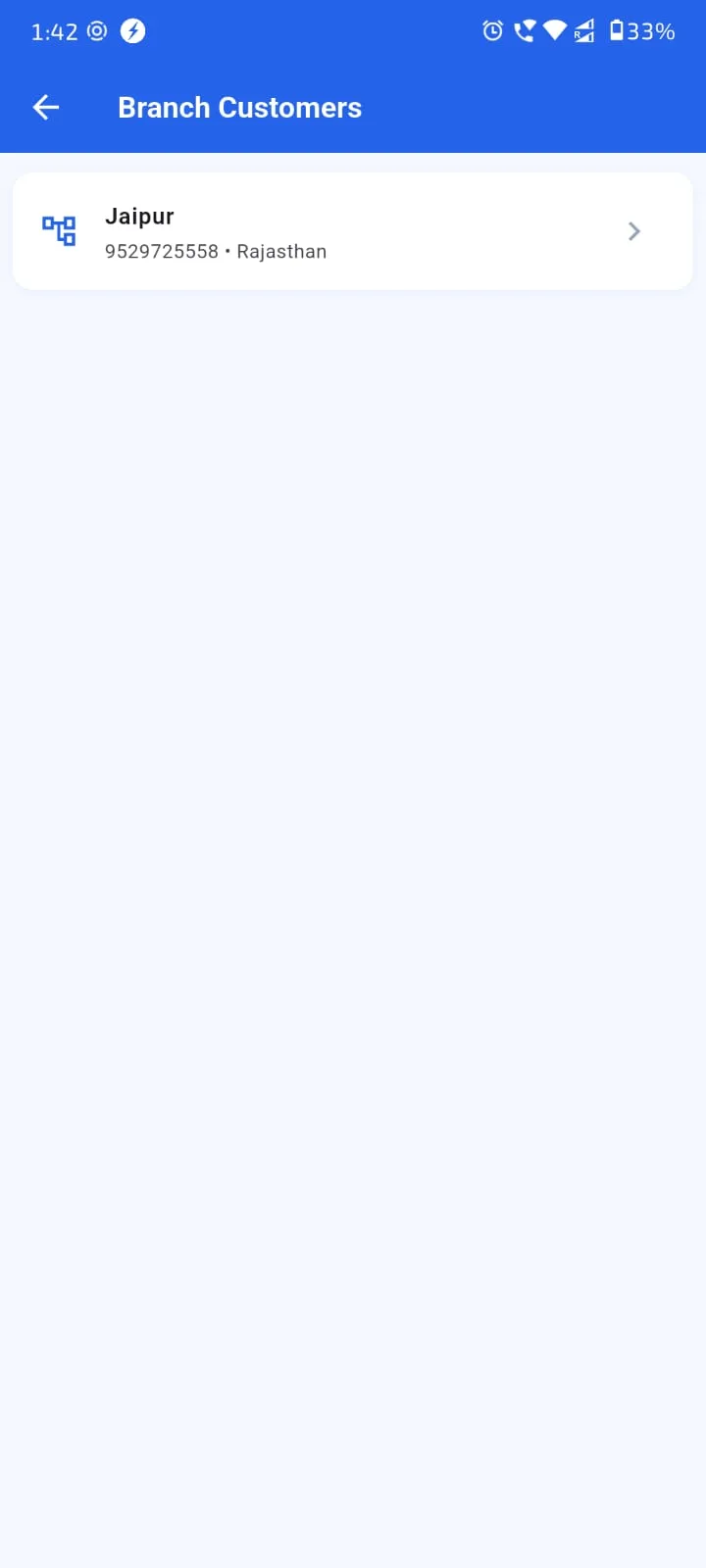
There's a specific moment in an insurance agency's growth journey where things stop being manageable from one location. It usually happens around the 1,000-1,500 active policy mark, or when the agency adds its second city. Up to that point, a single-location insurance agent app handles everything. Beyond that, you need real branch management — separate dashboards per branch, role-based access for branch managers, consolidated reporting for the owner, and clean policy transfers when customers move between cities. This guide explains what real multi-branch insurance agency management software looks like in practice, and what to look for when your agency hits this growth stage.
For context, the typical Indian insurance agency that reaches this stage usually started as a solo operation, hired one assistant, scaled to a small office, then started thinking about a second location. Each step demands different things from your software. The transition from single-branch to multi-branch is the one most agencies handle badly — usually by trying to extend their existing single-location workflow rather than properly setting up branch separation. A purpose-built best insurance CRM for agents with multi-branch support avoids the pain of that wrong scaling pattern.
Branch-Wise Dashboards — Right Information To Right Person
The fundamental principle of multi-branch operations is information segregation. The Mumbai branch manager should see Mumbai's renewal pipeline, Mumbai's commission run rate, Mumbai's customer list — not the Pune branch's data. The Pune branch manager should see only Pune's. Both branch managers may also need limited visibility into each other's data when a customer transfers, but that's an exception, not the default view.
A working client portfolio manage karne wala app at multi-branch scale sets up role-based access cleanly. Branch managers see their branch only. Branch staff see only the customers they're assigned to. The owner sees everything. Customers (via the customer self-service portal) see only their own policies. Each role has the data they need to do their job — no more, no less. This kind of access discipline isn't just about UX; it also matters for data privacy compliance.
Consolidated Reporting — The Owner View
For an owner running a multi-branch agency, the most important thing is the rolled-up consolidated view. Total active policies across all branches. Total premium under management. This-month renewal ratio across the entire agency. Top-performing branches. Underperforming branches. Top customers by lifetime value. Pending receivables aged by branch.
A proper insurance digital assistant app for multi-branch operations gives the owner this consolidated view in a single dashboard, while keeping branch-level dashboards intact for branch managers. Same data, different filters per role. The owner can drill from "Agency total" down to "Pune branch" down to "Pune branch's commercial vehicle line" down to a specific policy — all without leaving the dashboard. This kind of clean drill-down is what separates a real insurance agency management software from a glorified spreadsheet that pretends to be enterprise.
Try Agenex Free
Every Agenex feature is included on a free trial — no credit card required. The all in one insurance agent app for multi-branch insurance agencies.
Start Free TrialCross-Branch Policy Transfer — Customers Don't Stay In One City
Indian middle-class customers are increasingly mobile — job transfers, family relocations, business expansion. A customer who took a motor policy from your Indore branch may move to Pune and want their renewals handled from your Pune branch. Without multi-branch capability, this becomes painful: either you keep handling them from Indore (with shipping policy documents and confused contact), or you create a duplicate entry in Pune (with all the data hygiene problems that creates).
Cross-branch policy transfer should be a single-click operation. The customer record, all their policies, all their documents, their entire claim history — moved cleanly from one branch to another. Both branches retain the transfer audit trail. Commission tracking continues correctly under the new branch. The customer doesn't notice anything different in their customer renewal reminder software experience — they keep getting WhatsApp reminders, just now from the Pune branch instead of Indore.
Branch-Wise Sub-Agent Networks
Each branch typically builds its own local sub-agent / POSP network. The Mumbai branch may have 8 POSPs across the metro area. The Pune branch may have 4 POSPs covering Pune and Pimpri-Chinchwad. Each network operates locally, with its own commission slabs (which may vary based on local market rates), its own onboarding process, and its own monthly settlement cycle.
A multi-branch capable commission reconciliation software handles this cleanly. Each branch's sub-agent network is tracked separately. Each POSP's commission entries flow into their respective branch's commission MIS. End-of-month, each branch generates its own POSP statements; the owner sees the consolidated rollup. PoSP agent registration app data integrates here — when a new POSP registers through a branch, they're automatically tagged to that branch's network.
When Does Multi-Branch Software Make Sense?
Three clear signals that your agency has crossed the threshold and needs proper multi-branch software:
Signal 1 — Geography: You have customers in 2+ cities and team members handling them from 2+ locations. The most common pattern is a main office plus a satellite — Mumbai main + Pune satellite, Delhi main + Gurugram satellite, Coimbatore main + Erode satellite. Once both locations have local team members operating semi-independently, you need branch segregation.
Signal 2 — Volume: Your policy book has crossed 1,000 active policies and is still growing 30-50% annually. At this scale, you'll inevitably hire more people, those people will work from different desks (or different offices), and you'll need to know who handled what. Single-location workflows become information silos and accountability problems.
Signal 3 — Specialization: Different branches focus on different lines of business. Your Mumbai branch may focus on health insurance for corporate clients. Your Pune branch may focus on motor insurance for commercial vehicles. Each branch needs its own product expertise, its own commission slab configurations, its own customer engagement style. Multi carrier quoting software with branch-aware product catalogs becomes essential.
If none of these three signals apply, you don't need multi-branch software yet — and adopting it prematurely just adds complexity without value. A simpler insurance agent app works fine until growth genuinely requires more structure. Insurance lead manage kaise kare at a single-location scale is a different problem from doing it across multiple branches; only adopt the bigger toolset when the bigger problem actually exists.
FAQ
Multiple branches per agency account on the Platinum plan. Each branch operates independently but rolls up into the agency-wide owner dashboard.
Yes. Each branch can focus on its own primary lines — motor, health, life, general — while still having access to the full insurance policy tracking app for any cross-line opportunity.
Single-click transfer of customer record, all their policies, documents and claim history. Audit trail retained on both ends. The customer's WhatsApp reminder stream continues uninterrupted.
Yes — each branch can have its own commission slab configurations, especially useful when local market rates vary between cities or when each branch has different insurer-specific agreements.
Platinum plan at Rs.3,499/year supports multi-branch operations with consolidated owner dashboards, separate branch dashboards and cross-branch transfers built in.
Yes — each POSP onboarded through a branch is automatically tagged to that branch's network. End-of-month settlements roll up per-branch, with consolidated rollup at the agency level.
Yes — when a customer logs into their portal, they see their policies under whichever branch currently handles their account. If they get transferred between branches, their portal experience continues seamlessly.