
Different customers respond to different channels. The mistake most Indian insurance agents make is using a single channel for all renewals — usually WhatsApp, sometimes SMS, occasionally a hurried phone call right before expiry. The most effective renewal strategy is multi-channel, sequenced, and timed correctly. This guide walks through how a working customer renewal reminder software should orchestrate WhatsApp, SMS and voice across the renewal cycle for Indian customers — and why ignoring channel-mix discipline is the silent reason most agents lose 20-30% of their book annually.
For context, India has nearly universal WhatsApp adoption among insurance-buying customers, but not 100%. Older customers, government-sector workers, and rural customers often respond better to SMS or voice calls than to WhatsApp. A single-channel reminder strategy fails the segments that matter most. Related: Automated Renewal Reminder App, WhatsApp Renewal Reminder App, Policy Expiry Notification on WhatsApp, Bulk SMS Software.
WhatsApp As Primary Channel
The vast majority of Indian insurance customers are on WhatsApp. It has read receipts, supports rich media, allows quick replies, and feels personal without feeling intrusive. A working insurance agent app should send most renewal reminders via WhatsApp Business API with templated messages personalized to each customer.
Critical detail: WhatsApp templates need to be in the customer's preferred language. Sending Hindi templates to a Tamil-speaking customer feels generic. A proper insurance digital assistant app stores each customer's preferred language and uses it for outbound messaging automatically — Hindi, Tamil, Telugu, Bengali, Gujarati, Marathi, Punjabi, Kannada, Malayalam or English depending on what the customer set up at onboarding.
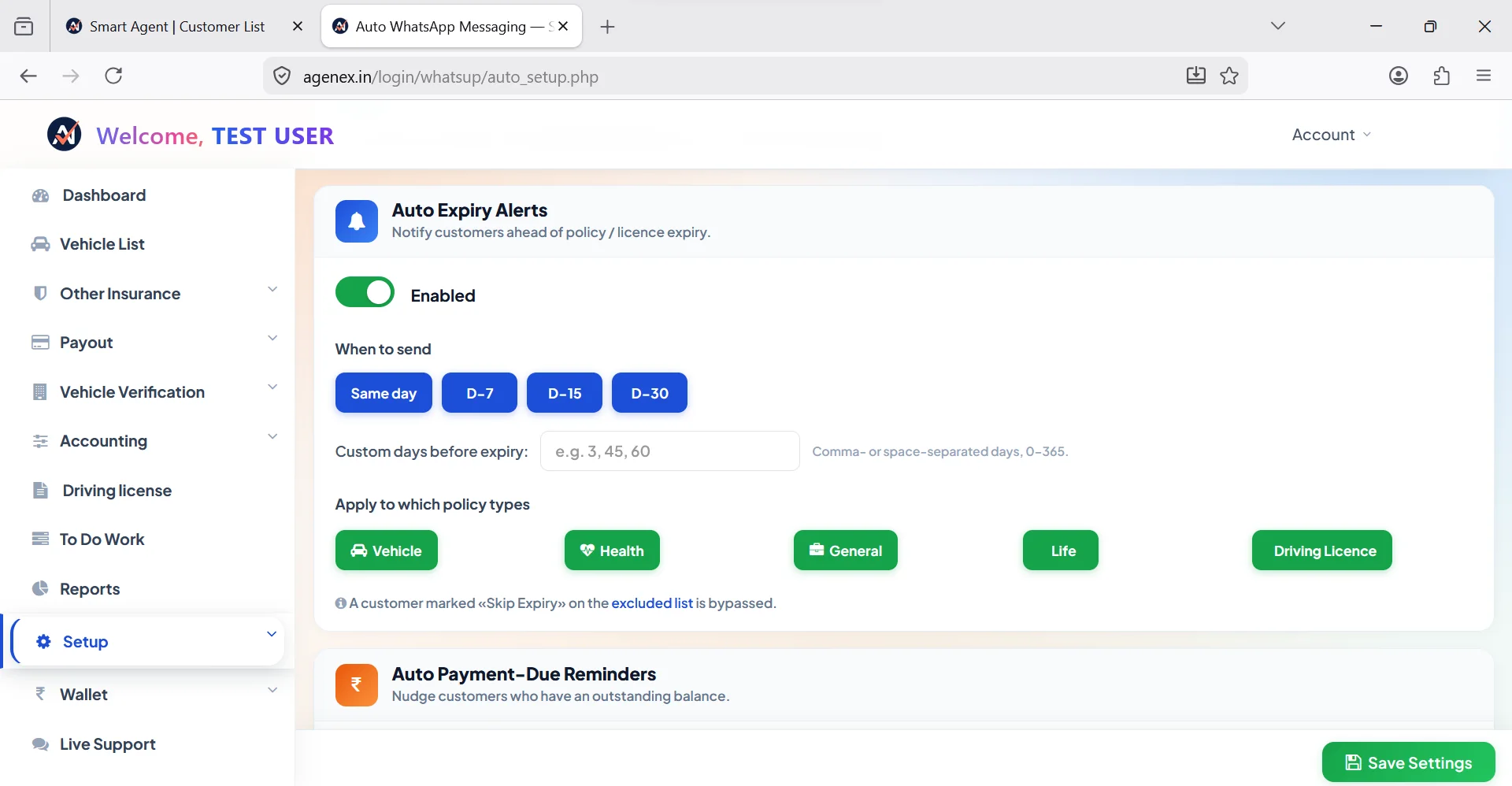
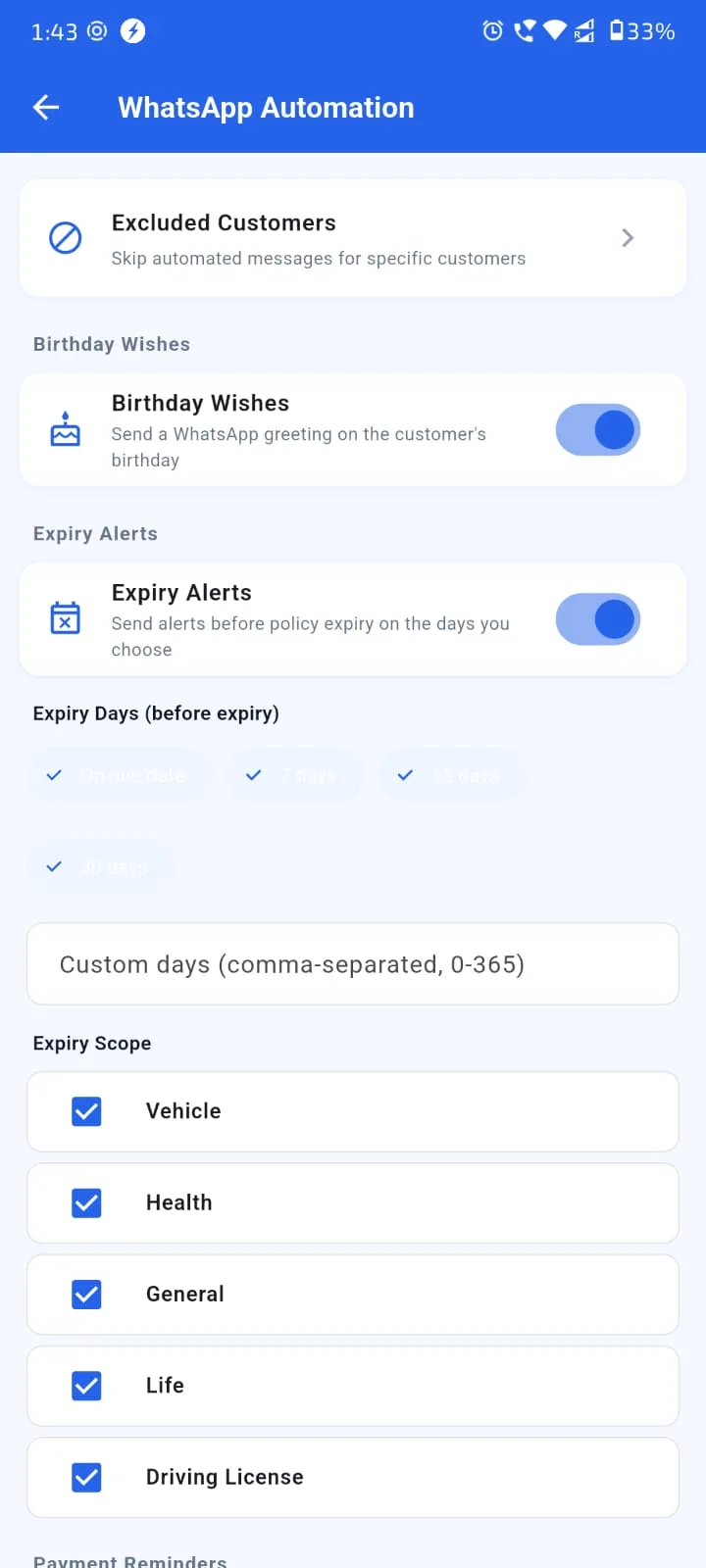
Cadence: 30 days pre-expiry (initial heads-up), 15 days pre-expiry (reminder), 7 days pre-expiry (urgency), 1 day pre-expiry (final call). All four touches via WhatsApp, all in the customer's language, all personalized with their name, policy details and renewal amount. This is the backbone of a good renewal cadence.
SMS Fallback For Non-WhatsApp Segments
For customers who don't actively use WhatsApp (or whose WhatsApp delivery fails), SMS becomes the fallback channel. Older customers, customers in remote areas with intermittent connectivity, and customers who use feature phones still respond to SMS. A working insurance lead tracking system should detect when a WhatsApp message hasn't been read within 24 hours and trigger an SMS automatically.
SMS in India operates under DLT (Distributed Ledger Technology) regulation — every SMS template must be pre-registered with telecom regulators. A proper renewal reminder system handles DLT registration as part of onboarding so agents don't deal with telco bureaucracy. SMS volume is typically billed separately from the subscription. See Bulk SMS Software for Insurance.
Try Agenex Free
Every Agenex feature is included on a free trial — no credit card required. The customer renewal reminder software with multi-channel orchestration built in.
Start Free TrialVoice Calls For High-Value Or Risky Renewals
Some renewals justify a personal phone call. High-premium policies (Rs.50,000+ annual), customers who skipped previous renewal touchpoints, customers with claim history (where they may be considering switching insurers) — all benefit from a personal voice call rather than relying on automation alone.
A working insurance agency management software automatically flags such cases on the agent's daily call list. Not every renewal needs a call — most can be handled by WhatsApp + SMS. But the high-value ones absolutely should get a personal touch. The system surfaces which ones; the agent handles them. This split between automated mass touchpoints and selective personal touchpoints is what makes the renewal workflow scalable while still feeling personal to customers who matter most.
Timing — When To Send Matters As Much As What To Send
Send times matter. A renewal reminder sent at 11 PM gets ignored. One sent during a customer's commute or meal time gets noticed. India-specific patterns most agents observe:
- Best send times: 10:30 AM - 12:30 PM (mid-morning, before lunch) and 4:00 PM - 7:00 PM (post-work, pre-dinner).
- Worst send times: 2:00 PM - 4:00 PM (lunch + post-lunch lull), 9:00 PM onwards (winding-down, family time).
- Day-of-week patterns: Tuesday-Thursday tend to perform better than Monday (catching up) or Friday (winding down).
- Festival sensitivity: Avoid major festival days for transactional messaging — feels insensitive. Send greetings instead, then resume renewal cadence after the festival.
Good customer renewal reminder software defaults to optimal time windows but lets agents customize for their specific customer base. Insurance lead manage kaise kare across renewals fundamentally means orchestrating the right message, in the right channel, at the right time, in the right language — and only software can do this consistently across hundreds of customers. See WhatsApp Reminders in Local Languages.
FAQ
WhatsApp first — most agents see significantly better engagement than SMS for the same content. SMS works as fallback when WhatsApp message hasn't been read within 24 hours.
Yes — DLT registration is handled as part of onboarding. Agents don't deal with telco regulatory paperwork directly.
Yes — defaults are optimized for typical Indian customers, but you can override per-template and per-customer-segment based on what works for your specific book.
Yes, but email is significantly less effective for Indian retail insurance customers. It works better for corporate prospects and group policy buyers.
WhatsApp messaging is included free within plan limits across Agenex plans. SMS volume is billed separately at standard telco rates. Voice calls happen from your own phone — no platform cost.